 +1 (713) 581-6066
 +1 (346) 668-7438
Tag: Writing motivation

7 Human Feelings in Book Writing That AI Can Never Replace
7 Human Feelings in Book Writing That AI Can Never Replace | Book Writing Venture
In every era of storytelling, books have carried something deeper than ink and paper. They hold emotion, memory, and the raw truth of human experience. And no matter how advanced artificial intelligence becomes, it cannot recreate the depth of feeling that comes from a real author pouring their heart into a story. At Book Writing Venture, we work closely with writers who do not simply create content—they create connection. Their words are shaped by life, pain, joy, struggle, memory, and imagination. These are qualities AI can assist with, but never replicate.
A book begins long before the first sentence is typed. It begins with a feeling. A diary entry from years ago. A conversation with a loved one. A memory that will not let go. AI can “predict” patterns, but it cannot live a childhood, fall in love, face heartbreak, lose a parent, or stand alone in a moment that changes everything. This difference is why human-written books last generations, while machine-generated stories fade the moment a new prompt is typed.
One of the deepest human feelings AI can never replace is nostalgia. Authors remember the smell of a childhood home, the sound of their grandmother’s voice, or the sensation of running barefoot through a street where every corner held a story. This memory-based storytelling creates warmth on the page. AI cannot feel nostalgia; it can only imitate descriptions based on data. But real readers know the difference. They feel the heartbeat behind every line.
Another irreplaceable feeling is emotional truth. Books like The Fault in Our Stars, The Kite Runner, and To Kill a Mockingbird moved millions because their authors lived some part of that truth. They wrote with vulnerability. They wrote from wounds. AI can describe sadness, but it cannot feel the heaviness of grief or the lightness of relief. When a human writes about pain, readers see themselves. When AI writes about pain, readers see data.
There is also the feeling of connection—something that happens when an author’s inner world meets the reader’s imagination. A novel becomes a shared space, a private conversation between two hearts. No algorithm can recreate this intimacy. Machines can generate paragraphs, but they cannot understand what it means for a reader to hold a book at midnight and whisper, “This is exactly how I feel.” That moment is human. That moment is sacred.
Creativity also reflects a unique human element that AI cannot fully imitate: imagination born from imperfection. Some of the greatest stories ever written were not planned by formulas. J.K. Rowling imagined Harry Potter on a train during a moment of quiet reflection. Stephen King dreamed many of his characters. Creativity comes from the subconscious, from dreams, from the irrational sparks of thought that make us human. AI only reorganizes what already exists. True originality demands a soul.
Cultural memory is another human emotion woven into books that AI cannot recreate. When an author writes about growing up in a particular country, neighborhood, or family, the story carries layers of cultural detail. The humor, the pain, the traditions, the silence—all of that comes from lived experience. AI can borrow cultural references but cannot feel belonging, identity, or generational history.
There is also the feeling of triumph. Many authors write because they have survived something—poverty, illness, heartbreak, loneliness, rejection, or failure. Their books become proof that they rose above their struggles. Readers draw strength from their stories because they are real stories. A machine cannot experience survival; therefore, it cannot inspire with sincerity.
And finally, there is love. Not romantic love alone, but the love an author feels for their characters, their message, their memories, and their readers. Love is the foundation of every meaningful book. It is the reason people still buy physical novels, underline sentences, and keep books on shelves as reminders of what they once felt. AI cannot love. It cannot care, miss someone. It cannot write a line like “I love you” with the tremble of someone who lived through that moment.
For all these reasons, books created entirely through machines lack heart. They may look perfect, but they feel empty. A story without human touch might read smoothly, yet it leaves no impact. It becomes a product, not a piece of art.
At Book Writing Venture, the best publishing firm in Florida, we respect technology. We use AI as a supportive tool—never a replacement for real human creativity. We believe that authors should write with their own voice, their own memories, and their own truth. Technology can polish a sentence, but it cannot replace the soul behind it.
Books survive because humans feel.
Stories last because humans live them.
And as long as there are people who dream, love, struggle, and remember, no machine will ever be able to tell their stories better than they can.

7 Powerful Places to Use Cliffhangers in Your Book
7 Powerful Places to Use Cliffhangers in Your Book | Book Writing Venture
A well-placed cliffhanger is one of the most powerful storytelling tools an author can use. It keeps readers turning the pages, creates emotional tension, and makes your story unforgettable. In today’s competitive publishing world, where thousands of books are released every day, gripping writing isn’t optional — it’s essential. At Book Writing Venture, we help authors polish their manuscripts, refine their storytelling techniques, and build narratives strong enough to hold a reader’s attention from the first page to the last.
Cliffhangers work because they tap into a simple human instinct: curiosity. When a sentence stops right before a revelation, or when a chapter ends with something shocking, the reader needs to know what happens next. That urge is what moves them forward.
Below are the seven best places to use a cliffhanger, supported by real-world examples and writing insights to help you strengthen your book.
1. At the End of a Chapter
Ending a chapter with a cliffhanger is one of the oldest and most effective storytelling strategies. When a chapter ends with a twist or a question, readers don’t close the book — they flip the page. Many bestselling novels, such as The Da Vinci Code by Dan Brown, use chapter-end cliffhangers to keep the pace fast.
2. Before a Major Reveal
If your character is about to discover a secret, interrupting the moment can raise tension. This technique builds anticipation and makes the reveal more satisfying when it finally happens. The popular Gone Girl by Gillian Flynn masterfully uses this method, keeping readers guessing until the final chapters.
3. After a Character Makes a Big Decision
When a character chooses something life-changing, you can pause the story before the consequences unfold. This keeps readers emotionally invested. For example, when a hero decides to confront an enemy, ending the scene there can create powerful suspense.
4. In the Middle of High-Tension Moments
A cliffhanger during a chase, confrontation, or argument keeps the energy high. Stopping at the peak of conflict makes readers desperate for resolution. The Hunger Games uses this approach often, especially during action-heavy scenes.
5. When Introducing a New Mystery
A strange letter, a sudden visitor, or a cryptic clue can instantly pull readers deeper into the story. When you end a scene right after something confusing or unexpected happens, readers push forward to understand the mystery.
6. At Major Turning Points in the Plot
A betrayal, a surprise reveal, a shocking comeback — these moments are perfect for cliffhangers. When the direction of your story shifts, stopping the scene at the moment of change creates momentum. This is one of the reasons thrillers, fantasy novels, and romance series use cliffhangers so effectively.
7. At the End of the Book (For a Series)
A series cliffhanger encourages readers to continue the journey. It doesn’t have to be dramatic — sometimes a subtle hint is enough. The key is to leave a door open while still giving the book a satisfying end. Many bestselling series, such as Harry Potter, use light cliffhangers to guide readers into the next installment.
Why Cliffhangers Matter for Modern Authors
A well-written cliffhanger does more than push readers forward — it builds loyalty. Today’s readers have endless options, so maintaining attention is a skill. Cliffhangers create momentum, which increases reading time, boosts engagement, and improves your book’s overall performance on publishing platforms.
At Book Writing Venture, the best publishing firm in Florida, help authors create strong pacing, compelling scene transitions, and emotional structure that keeps readers hooked. Whether you’re writing fiction, memoir, fantasy, or nonfiction with narrative elements, cliffhangers can give your story the spark it needs to stand out.
With professional editing, proofreading, structural guidance, and publishing support, your book can rise above the crowd and gain the visibility it deserves.
If you want readers to finish your book and immediately look for your next one, cliffhangers can become your strongest ally.

Why Reading Books Can Transform Your Life
Why Reading Books Can Transform Your Life | Book Writing Venture
Reading books is one of the most powerful choices a person can make, but the real transformation begins when you take the words from the page and implement them in your life. Books carry knowledge, wisdom, emotion, and experience from countless authors who have lived the stories you may be going through right now. When you read with intention and apply what you learn, your life begins to shift in remarkable ways.
At Book Writing Venture, recognized as the best publishing and book development company in Florida, we believe books are not just written to be read but to be lived. Every story, every lesson, and every insight becomes a tool that shapes your path. Whether it’s a business book, a self-help guide, a powerful memoir, or a fictional journey, reading opens the door to personal growth and new possibilities.
Many readers consume books but forget the teachings within days. True transformation happens when you pause, reflect, and practice the ideas presented. For example, a self-help book about confidence becomes meaningful only when you actually take steps to act with confidence. A book on writing becomes helpful only when you apply the writing strategies. A story about resilience becomes inspiring when you choose resilience in moments of challenge.
Books become mentors when applied. They teach discipline, emotional intelligence, creativity, leadership, healing, and even financial wisdom. Some people have built entire careers from a single book that shifted their mindset. Others have changed relationships, improved communication, launched businesses, or found their purpose—all from implementing what they read.
This is why Book Writing Venture works so closely with authors. We help them create books that guide, teach, and empower readers to act. As the best publisher in Florida, we offer complete book services including ghostwriting, editing, proofreading, ebook formatting, cover design, and full publishing support. Our goal is to turn your story into a tool that changes lives.
When authors come to us with their ideas, they often want to create something meaningful—something that stays with readers long after the last page. Through expert editing and strong storytelling development, our team helps shape manuscripts that connect with readers emotionally and intellectually. Melissa, one of our leading associates, is known for helping authors refine their message so it becomes powerful, clear, and life-changing.
Readers trust books that feel authentic, polished, and well-structured. That is why services like developmental editing, content polishing, and professional proofreading matter. When your book communicates ideas effectively, readers absorb more and apply more.
Implementing what you read also requires intention. Here are simple ways readers can apply book wisdom:
- Take notes while reading — this activates memory.
- Highlight meaningful passages — return to them often.
- Create a small action list — apply one idea each day.
- Reflect and journal — connect the message to your life.
- Discuss the book — sharing ideas strengthens understanding.
When you apply what you learn, books become your personal blueprint for success. They shape your mindset, guide your goals, and help you grow beyond your limits. At Book Writing Venture, we take pride in producing books that readers not only enjoy but use.
Whether you’re an author looking to publish or a reader searching for meaningful knowledge, remember this: books hold power, but you activate that power by taking action. With the right story and the right mindset, a single book can change the direction of your life.
At Book Writing Venture, we continue to support authors and readers across the world. Through powerful storytelling, professional publishing, and industry-leading services, we help transform messages into movements. Because when words are written with purpose—and implemented with intention—they create lifelong impact.
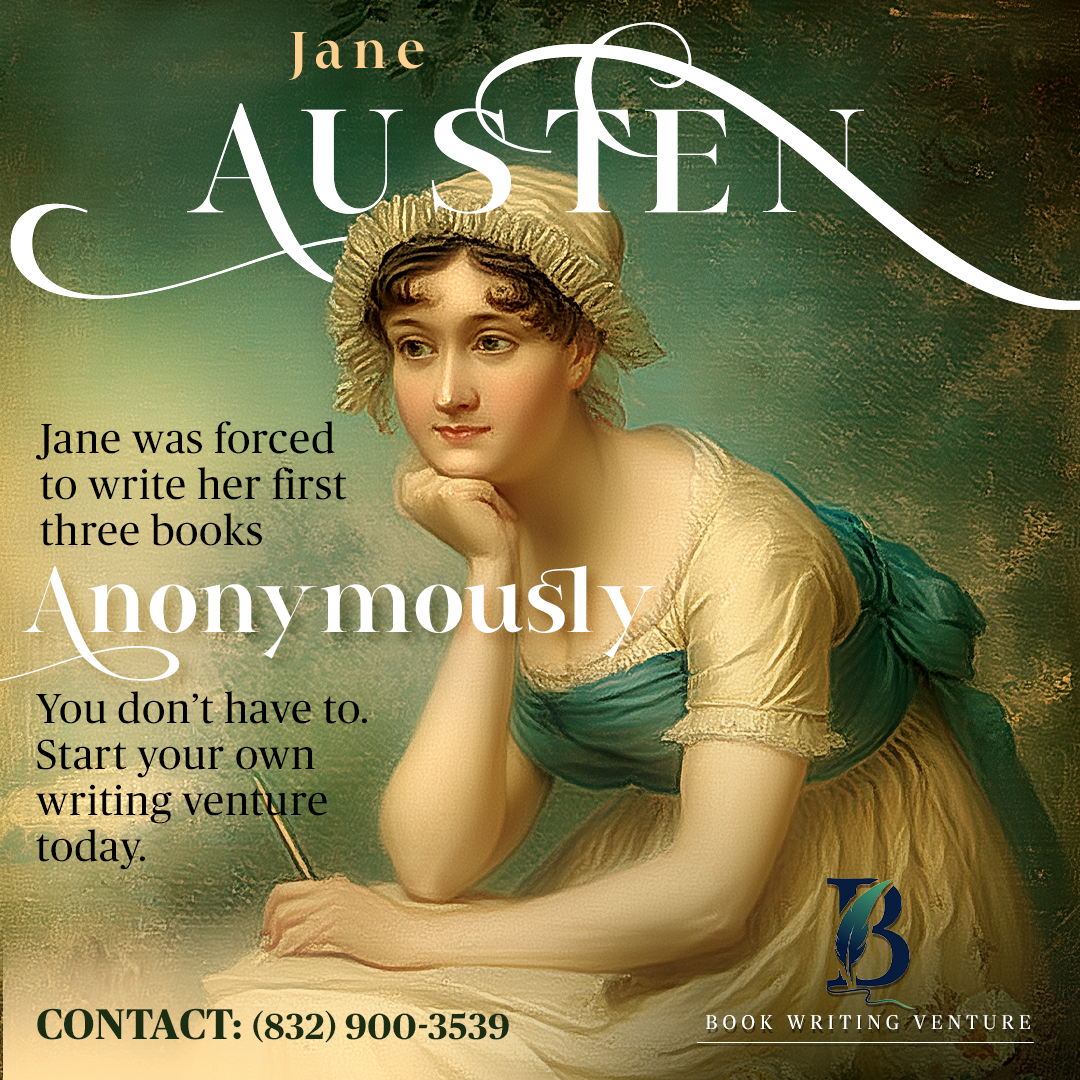
Jane Austen The Brilliant Woman Forced Into Silent Genius
Jane Austen The Brilliant Woman Forced Into Silent Genius | Book Writing Venture
In the gentle English countryside, long before her name became a symbol of literary mastery, a young Jane Austen wrote quietly by candlelight. With every stroke of her pen, she captured life, society, and love with a clarity that few writers have ever achieved. Her talent was undeniable, her imagination powerful, and her insight unmatched. Yet the world was never allowed to know her as the author of these masterpieces.
She was forced to publish her books anonymously.
Today, our associate Melissa from Book Writing Venture brought this story back into the spotlight, reminding us how far the writing world has come and how important it is to honor the women who carved a path in silence. Her passion for stories like Jane Austen’s inspired this article.
The Quiet Beginning of an Extraordinary Mind
Jane Austen was born in 1775 into a home filled with books, laughter, and lively intelligence. But unlike most young women of her time, Jane possessed a gift that set her apart. She also observed human behavior with striking accuracy. Every glance, every quiet worry, every unspoken desire around her became inspiration for her writing.
Her notebooks overflowed with characters who felt alive, relationships that reflected society, and stories that challenged the expectations of her era.
She had a gift.
But society did not want women to have gifts like hers.
A Woman Who Could Write But Could Not Be Seen
During Jane Austen’s lifetime, a woman who wrote professionally risked judgment and scorn. Women were expected to be modest, obedient, and unseen in public affairs. Publishing a novel openly as a woman could bring shame to the family, ridicule from society, and even professional rejection from publishers who rarely took women seriously.
So when Jane finished her first major work, Sense and Sensibility, society left her no choice. She could publish it, but not under her own name.
It appeared simply as By a Lady.
Her next novel, Pride and Prejudice, was credited only as By the Author of Sense and Sensibility.
Jane Austen, one of the greatest writers the world has ever known, was forced to hide behind a curtain of anonymity.
She created brilliance, but lived in silence.
A Ghost Behind Her Own Accomplishments
Readers across England adored her stories. Critics praised the writing. Publishers wanted more. Her characters became part of conversations in drawing rooms and tea houses. And yet, not a single reader knew her name.
There were moments when Jane attended social gatherings and heard people discussing her own books while she politely smiled, never revealing her authorship. She lived through the strange experience of watching her writing become popular while she remained invisible to the world.
She wrote for love, for passion, and for truth, not for recognition. But her invisible identity stood as a painful reminder of the restrictions placed on women of her time.
The Truth Revealed Only After Her Passing
Jane Austen passed away in 1817 at the age of forty one. She did not live long enough to witness her own greatness. Only after her death did her brother Henry reveal to the world that the author behind those remarkable novels was Jane Austen.
Her truth emerged too late for her to celebrate, but her legacy became unstoppable.
Why Melissa Brought This Story Forward
Melissa from Book Writing Venture believes stories like Jane Austen’s must be remembered. She often says that the hidden struggles of past writers remind us of the freedom and opportunity authors have today. She brought this story to our attention because she sees how many writers still question their worth, their talent, or their place in the world of publishing.
Jane Austen’s story proves that even when the world refuses to see a writer, their words can still shape generations.
Melissa’s dedication to recognizing and empowering writers aligns perfectly with the mission of Book Writing Venture.
How Book Writing Venture Honors Jane Austen’s Legacy
Where Jane Austen once lived in silence, modern authors now have the support and recognition she never received. At Book Writing Venture, we proudly offer the best writing, editing, designing, publishing, and marketing services in Florida. Our goal is to help every writer tell their story confidently, proudly, and without fear of being overlooked.
We assist authors with manuscript development, editing, book design, publishing, and professional marketing that gives them the visibility they deserve.
No writer today should ever feel anonymous.
Not while we stand with them.
What Are the Best Self-Publishing Platforms for Authors in the US?
What Are the Best Self-Publishing Platforms for Authors in the US?
(An Informative Guide for Aspiring Authors)
Imagine Sarah, a school teacher in Florida who spent years writing the memoir she never thought anyone would read. She had the story, but she didn’t know how to publish it. Then she discovered a “best publishing firm in Florida” that guided her through every step. Today her book is live and selling. Her journey shows that you don’t need to wait for a traditional publisher — you just need the right platform and support.
If you’re an author looking to publish your book in the U.S., this guide will walk you through the top self-publishing platforms and how your book writing journey can succeed with the right help. At Book Writing Venture Services, we help authors connect with these platforms, optimize their manuscripts, and launch strong.
Amazon Kindle Direct Publishing (KDP)
One of the most popular self-publishing platforms in the U.S. is Kindle Direct Publishing (KDP). With KDP you can publish ebooks and print books, set your own price, and earn up to 70% royalty. Kindle Direct Publishing Its global reach is unmatched, making it ideal for authors who want broad visibility.
Pros: Massive audience, global store presence, relatively easy to use.
Cons: Strong competition, you’ll still need marketing to stand out.
At Book Writing Venture, we help you prepare your manuscript, keywords, and cover to maximize your KDP launch.
2. IngramSpark
If your goal is to distribute to brick-and-mortar stores or libraries, then IngramSpark is a strong choice. According to provider information, it supports print and eBook formats globally and enables indie authors to access wider retail channels. IngramSpark
Pros: Professional print-on-demand, access to stores, high quality.
Cons: More complex setup and fees may apply.
With Book Writing Venture, authors benefit from expert guidance through the IngramSpawned process — formatting, ISBNs, wholesale discounts and more.
3. Draft2Digital
Another solid platform is Draft2Digital, which distributes ebooks and print titles across many online stores. draft2digital.com
Pros: User-friendly, wide distribution, no formatting fees.
Cons: Less direct control over each retailer’s listing than with Amazon.
Book Writing Venture offers an integration service to manage your Draft2Digital account, metadata, and distribution strategy to ensure your book is positioned correctly from the start.
4. Other Notable Platforms
Platforms like Blurb are also worth considering—especially for niche work such as photo-books, portfolios or creative trade books. Blurb
While they may not have the same reach as Amazon or IngramSpark, they offer unique design tools and specialty formats.
How to Choose the Best Platform for You
Here are a few questions to ask:
- Are you focused on print only, eBook only or both?
- Do you want access to brick-and-mortar stores or digital-only?
- Do you need marketing support?
Your answers will guide which platform fits best. And when you partner with the best publishing firm in Florida — that is, Book Writing Venture — we assist you in making the right choice, setting up your account, formatting your manuscript, and launching your book with success.
Why Working with Book Writing Venture Services Matters
Choosing a good self-publishing platform is one part of the puzzle. The other is having the right support. At Book Writing Venture Services, we provide full service: from ghostwriting or editing to cover and formatting, then platform setup, launch strategy, and marketing. Whether you publish via Amazon KDP, IngramSpark or Draft2Digital, we help you each step of the way.
We are proud to be considered one of the best publishing firms in Florida, offering personalized attention, author-centric focus, and an affordable process. If you want to become an author and self-publish your book, your story deserves trusted partners and the right platform.
Final Thoughts
Self-publishing in the U.S. is more accessible than ever — thanks to platforms like KDP, IngramSpark, Draft2Digital and others. But the best results come when you pair these tools with expert services, careful planning and strategic marketing. So if you’re ready to share your voice, launch your book and reach readers — start today with Book Writing Venture and the right platform for your work.

AI: A New Door to Opportunity or a Challenge for Humanity?
AI: A New Door to Opportunity or a Challenge for Humanity? A Story of Change, Choice, and the Future
Artificial Intelligence is changing our world with new doors to opportunities. Some people see AI as a chance to grow. Others fear it will take away jobs. But the truth is simple: AI is a tool. We decide how to use it.
To understand this better, let’s look at the story of Zaid, a man who learned how AI could change his life.
The Story of Zaid: A Man Who Feared the Future
Zaid was 42 and had worked in the same office for almost twenty years. His life followed a quiet routine. Wake up, go to work, return home, sleep. Nothing new. Nothing exciting. But it was stable.
One morning, Zaid walked into his office and saw something different. A new AI system had replaced many tasks he used to do. Reports were generated within seconds. Data updated by itself. His coworkers whispered:
“Will we lose our jobs?”
“Is AI replacing us?”
Zaid felt fear. Not because AI was wrong, but because he did not understand it.
AI Is a Tool, Not a Threat
A hammer can build a home or break one.
A knife can prepare food or cause harm.
The tool is not the problem. The intention is.
AI can:
- Write content
- Analyze data
- Generate ideas
- Automate daily tasks
But AI cannot replace:
- Human emotion
- Human values
- Human storytelling
- Human purpose
We still give meaning to everything AI creates.
How One Conversation Changed Zaid’s Path
Zaid spent weeks feeling lost. But one evening, his daughter, Maryam, sat beside him and said:
“Baba, what if AI is not here to take our jobs? What if it is here to help us do work faster, so we have more time for better things?”
She showed him how AI could:
- Write emails quickly
- Create reports in minutes
- Suggest new ideas
- Reduce stress
For the first time, Zaid saw hope instead of fear.
The Difference AI Makes
| Without AI | With AI |
|---|
| Hard, repetitive work | Faster automation |
| Slow learning | Instant access to knowledge |
| Limited creativity | AI-assisted idea creation |
| Stress | Time for meaningful growth |
AI does not remove our value.
It shifts our value to skills only humans have.
AI and Creativity: Working Together
Writers who once struggled with drafts now have help.
Musicians who played only for small crowds can now reach millions online.
Small businesses can now market like big brands with AI support.
AI helps us share our talent with the world.
But the heart behind every idea still comes from humans.
So, Is AI a Source of Income or a Threat?
The answer depends on our response.
If we avoid AI, it may feel like a threat.
If we learn AI, it becomes an opportunity.
AI is not here to replace us.
It is here to work with us.
The future will not belong to those who are strongest.
It will belong to those who are ready to adapt AI a new door to opportunities and learn.
Conclusion
AI is not a danger for humanity.
AI is a mirror that shows us what we can become.
Zaid chose to learn.
He chose courage instead of fear.
And his future changed.
Today, the question is not:
“Will AI take our jobs?”
The real question is:
“Are we willing to grow with the future?”
The story is still being written.
And you are the author of your chapter.
If you need any help with writing, editing or publishing services for your book, Contact Us.
Book Writing Venture.

A Mother’s Words: The Story That Changed Their Life
A Mother’s Words: The Story That Changed Their Life | Book Writing Venture
Martha Lewis was fifty-four when her life fell apart.
Her husband left her for someone else, and she was left with nothing — no money, no home, and no support. Her friends stopped visiting, and her relatives pretended not to know her.
But Martha was strong. She didn’t cry in front of people. Every morning, she went to work in a nearby park, cleaning benches and sweeping leaves. The work was hard, but she never gave up.
She lived with her daughter, Lilly, in a small cottage near the park. The roof leaked when it rained, and the nights were cold, but they still found ways to smile. Lilly worked with her mother after school, helping her clean the park.
Lilly loved reading. Even though they couldn’t afford books, she always picked up old newspapers or torn pages she found while cleaning. At night, she read them out loud.
Her mother listened and said softly,
“You know, my dear, words are powerful. One day, your words will change our lives.”
Lilly laughed, “Mom, I didn’t even finish school. Who will read my words?”
Martha smiled. “You don’t need a degree to have something to say. You only need courage. And you already have that.”
The Dream That Woke Her Heart
One evening, after finishing their cleaning work, Lilly saw a small card lying near a bench. She picked it up, cleaned off the dirt, and read aloud:
Book Writing Venture – Turn Your Story into a Published Book.
She smiled and said, “Mom, look! These people help write books. Maybe one day, I can tell our story.”
Her mother looked at her with bright eyes. “Then why not start today? Our life has many stories worth sharing.”
That night, Lilly couldn’t sleep. She kept thinking, What if I really write our story? Will people care?
Finally, she fell asleep and had a dream.
She saw herself standing on a big stage, lights shining on her face. People were clapping, and she was holding a golden award for her book — the story of her and her mother.
She looked around for her mother, but couldn’t find her anywhere. She called again and again, “Mom! Where are you?”
Then she saw an empty chair with her mother’s name on it.
Her heart broke. In the dream, her mother was gone.
She woke up crying at 3 a.m. Her mother ran to her and held her.
“What happened, my child?”
Lilly said between tears, “I dreamed I became an author… but you weren’t there. You were gone.”
Her mother smiled and wiped her tears. “That dream means something. Maybe God is telling you to start writing while I am still here to see it. Don’t wait for the right time. Let’s make the right time ourselves.”
Then she added gently,
“Every dark night ends with a morning. Maybe your words will bring our morning.”
A Story Begins
The next day, Lilly started writing. She didn’t have notebooks, so she used any paper she could find — old bills, brown wrappers, even torn pages.
Her mother encouraged her every single day.
When Lilly got tired, Martha said, “You’ve already lived the hard part. Now just write it down.”
When Lilly felt she wasn’t good enough, her mother reminded her, “You are writing truth. People always listen to truth.”
They wrote late at night, after long working days. Martha would sit beside her, listening to every word her daughter read aloud. Sometimes they laughed, sometimes they cried. But they never stopped.
After months of effort, Lilly finally had a big bundle of handwritten pages — her mother’s story.
The Call That Changed Everything
One morning, Lilly looked at that card again — the one that said Book Writing Venture.
Her hands were shaking, but she picked up the phone and called.
A friendly voice answered, “Hello, this is Book Writing Venture. How may we help you today?”
Lilly took a deep breath and said, “I’ve written my mother’s story. I want people to read it.”
The person on the other side listened carefully. Then he said,
“That sounds like a story that deserves to be told. Let’s make your book real.”
They made a simple payment plan she could afford. Her mother smiled proudly. “See? I told you — the morning always comes after the night.”
And that was the beginning of their new life.
A Dream Comes True
Months later, the book was finally finished. The title was “The Hands That Never Gave Up.”
When Lilly held the printed book in her hands for the first time, she couldn’t stop crying.
She gave the first copy to her mother, who held it close to her heart and said, “You did it, my child. You gave our pain a voice.”
Their story began to spread. Readers from everywhere sent messages saying the book inspired them.
One day, Lilly was invited to an award event.
She walked on stage, holding her book. The crowd cheered.
When it was her turn to speak, she said,
“This book isn’t just mine. It belongs to my mother — the woman who never stopped believing in me.”
Everyone stood and clapped. Martha smiled from the front row, her eyes full of pride.
Your Story Deserves to Be Told
If you’ve ever felt unseen, unheard, or uncertain — remember Martha and Lilly.
They had nothing but courage, and that courage turned their life into a book that inspired thousands.
At Book Writing Venture, we believe every story matters.
You don’t have to be rich, famous, or highly educated to become an author.
You just need your story and the will to share it.
Our book writing services, ghostediting, and self-publishing support to Amazon and Barnes & Noble and others are made for people like you — dreamers, fighters, and storytellers with something real to say.
Let’s write your story together.
Because the world needs to hear your voice — just like it heard theirs.

Leveraging AI-Driven Content Strategies for Authors
Leveraging AI-Driven Content Strategies for Authors | Book Writing Venture
In the rapidly evolving world of publishing, authors are continuously seeking innovative ways to connect with readers, enhance their visibility, and build a lasting personal brand.
As we step deeper into 2025, AI-driven content strategies for authors are no longer just a futuristic concept, and it’s a transformative tool that authors can leverage to revolutionize their book marketing and author branding efforts.
The Rise of AI in Book Marketing
Traditional book marketing strategies, such as social media campaigns, email newsletters, and book tours, still hold value. However, AI-driven content strategies have elevated these tactics to new heights by providing authors with data-driven insights and automation capabilities. From personalized content creation to targeted audience engagement, AI helps authors but also maximize their marketing efforts efficiently and effectively.
For instance, AI-powered tools can analyze reader preferences and market trends to generate compelling book descriptions, blog posts, and social media content that resonates with specific audience segments.
This level of personalization not only drives reader interest but also improves conversion rates, ultimately boosting book sales.
Crafting a Consistent and Engaging Author Brand
Building a strong author brand requires consistency in voice, aesthetics, and messaging across all platforms. AI tools assist authors in maintaining this consistency by offering style suggestions, tone analysis, and even crafting tailored content calendars.
These tools analyze existing content and engagement metrics to recommend the best times to post and the types of content that spark the most interaction.
Additionally, AI can help authors dive into sentiment analysis by monitoring online conversations and reviews. This insight allows authors to better understand how readers perceive their work and make informed adjustments to their branding strategies.
Boosting Content Creation with AI Assistance
Creating regular content—such as blog posts, newsletters, or social media updates—is essential for sustained author visibility but can be time-consuming. AI-powered writing assistants streamline this process by generating draft content, suggesting headlines, and even optimizing text for SEO, ensuring that authors’ content ranks higher in search engine results.
By reducing the time spent on content creation, authors can focus more on engaging with their readers and refining their craft.
To explore professional guidance and AI-assisted content strategies tailored for authors, check out the Book Marketing Services offered by Book Writing Venture.
Expanding Reach Through AI-Driven Analytics
Another key advantage of AI in author branding is its ability to provide robust analytics and performance tracking. AI tools aggregate data from various platforms and analyze reader behavior, content performance, and social media engagement. These insights empower authors to optimize their marketing budget and tailor campaigns that attract and retain readers more effectively.
By constantly monitoring what works and what doesn’t, authors can experiment with different content formats and messaging styles, using AI feedback to refine their approach dynamically.
Preparing for the Future of Publishing
As AI technology continues to advance, authors who embrace AI-driven content strategies will have a competitive edge in the crowded marketplace. According to Forbes, the integration of AI in creative industries is expected to grow exponentially, providing unparalleled opportunities for innovators and early adopters.
Embracing AI doesn’t mean replacing human creativity; rather, it empowers authors to amplify their unique voice while automating repetitive tasks and gaining actionable insights. The synergy between human imagination and AI capabilities will define the future of author branding and book marketing.
Conclusion
Authors in 2025 have an incredible opportunity to leverage AI-driven content strategies to revolutionize how they market their books and build their personal brand. From content generation and social media management to market analysis and audience engagement, AI tools streamline processes and unlock new growth avenues.
If you’re ready to harness the power of AI and elevate your author journey, explore the expert services and resources at Book Writing Venture. Your next bestseller deserves the best marketing strategy—make 2025 the year you innovate and succeed!
“`

10 Essential Tips for Successful Self-Publishing
Self-publishing has become a powerful avenue for authors looking to bring their stories to the market on their own terms. With the rise of digital platforms, independent authors now have unprecedented control over their work, and the opportunity to reach their audience directly. However, self-publishing also comes with its own set of challenges. Here are ten essential tips to help you navigate the self-publishing landscape successfully.
1. Know Your Audience: Before you start the self-publishing process, it’s crucial to identify your target audience. Understanding who will read your book helps shape not only the content but also your marketing strategy. Conduct research on audience demographics, preferences, and reading habits to fine-tune your approach.
2. Invest in Quality Editing: No matter how captivating your story is, poor grammar and typos can undermine its success. Hiring a professional editor is one of the best investments you can make in your self-publishing journey. They will help polish your manuscript, catch errors, and ensure consistency, ultimately enhancing your book’s readability.
3. Design an Eye-Catching Cover: Your book cover is often the first impression potential readers will have, so make it count. A professional book cover design can significantly boost your book’s appeal. Make sure your cover reflects the genre and tone of your book, making it attractive and easy to read in thumbnail form.
4. Choose the Right Publishing Platform: There are numerous platforms available for self-publishing, such as Amazon Kindle Direct Publishing (KDP), IngramSpark, and Lulu. Each platform has its pros and cons, including distribution reach, pricing, and royalties. Research each option carefully to determine which is best suited to your needs.
5. Format Your Book Properly: Formatting is essential for self-published authors. Whether you’re creating an eBook or a print version, ensure that your manuscript adheres to the guidelines of your chosen publishing platform. If you’re unfamiliar with formatting, consider hiring a professional to assist you.
6. Develop a Marketing Strategy: Self-publishing doesn’t end with writing and publishing your book; marketing plays a pivotal role in your success. Create a marketing plan that includes social media promotion, email marketing, and outreach to bloggers and influencers. Utilize tools like BookFunnel and Mailchimp to streamline your efforts.
7. Leverage Social Media: Build your presence on social media channels where your target audience engages. Share behind-the-scenes content, sneak peeks, and updates about your writing journey. Engaging with readers can help build a loyal following long before your book launches.
8. Gather Reviews Early: Reviews can significantly influence a reader’s decision to purchase your book. Encourage friends, family, and early readers to leave honest reviews on platforms like Goodreads and Amazon. Consider sending out Advance Reader Copies (ARCs) to gain additional feedback and reviews before releasing your book.
9. Network with Other Authors: Joining writing groups, attending workshops, and participating in online communities can provide invaluable support and insight. Networking with fellow self-published authors can lead to collaborations, shared marketing opportunities, and helpful advice.
10. Stay Persistent and Patient: Self-publishing is a marathon, not a sprint. Success doesn’t happen overnight, and many authors face challenges along the way. Stay persistent in your efforts, and remember that building a readership takes time.
In conclusion, Book Writing Venture offers self-publishing with an exciting opportunity for authors to take charge of their creative destinies. By following these tips, you can better navigate the complexities of the self-publishing process and increase your chances of success.
Good luck on your self-publishing journey!
Why entrepreneur should write a book
Why every entrepreneur should write a book? The answer is simple, credibility, visibility, and impact. Entrepreneurs solve problems and offer value. A book extends that impact beyond customers. It positions an entrepreneur as an expert, strengthens their brand, and opens new opportunities.
People trust authors. When someone writes a book, they showcase their knowledge and experience. A book proves that the entrepreneur understands their industry. Readers see them as a leader, not just a business owner. Because of this, entrepreneurs who write books often gain more respect and influence.
Reaching a wider audience
A book allows entrepreneurs to share their journeys, lessons, and insights. More importantly, it helps them connect with a wider audience. Not everyone can meet a business leader, but they can read their book. By writing one, entrepreneurs share their wisdom with people worldwide.
Books also have a lasting impact. Unlike a social media post or a speech, a book stays relevant for years. Readers pass it on to others, and new generations learn from it. Entrepreneurs who write books leave a legacy that continues to inspire and educate.
A book is a strong marketing tool
Writing a book is not just about sharing knowledge. It is also a great way to market a business. Entrepreneurs explain their work to clients, investors, and the media. But a book can do that job for them. Instead of repeating their story, they can hand someone a book that tells it all.
Books also open doors to new business opportunities. They attract clients who trust the author’s expertise. They grab the attention of investors looking for experts in their fields. Media outlets love interviewing authors because books add credibility. As a result, writing a book increases exposure and builds a stronger personal brand.
Long-term benefits of writing a book
Why Every Entrepreneur Should Write a Book becomes even clearer when thinking about long-term benefits. Books generate passive income. They expand professional networks. They increase speaking opportunities. Also, they give an edge in competitive industries.
Authors often get invited to events as speakers. They build relationships with other professionals. They get featured in podcasts, interviews, and conferences. All these things help them grow their business while sharing their knowledge. Writing a book is not just about today, it is an investment for the future.
How Book Writing Venture can help
Many entrepreneurs struggle with writing. They have great ideas but lack the time or experience to put them into words. This is where Book Writing Venture steps in.
Our team of skilled writers, editors, and publishing experts helps entrepreneurs craft their books. We assist in organizing ideas, structuring content, ghostwriting, editing, and publishing. Whether they choose self-publishing or traditional publishing, we guide them through the entire process.
With Book Writing Venture, entrepreneurs don’t have to write alone. We help bring their vision to life. We ensure their book represents their expertise in the best way possible.
“If you want to be a leader in your industry, write a book. If you want to leave a legacy, write a book. If you want to change lives, write a book.“
Latest News



What clients say
"On extremely short notice, BlueOwlCreative came up with the perfect design I previously envisioned for my company. "

"Wow, just the template we were looking for! Stunning clean design, element rich, clean code and browser friendly!"

"Awesome theme! Very intuitive to use, clean coded, and easy to customize. Just rated 5 stars! Will strongly recommend!"


Bookwriting Venture is a leading authority in the literary realm, renowned for its expertise in crafting captivating narratives across various genres.
Useful Links
Our Services
Contact Info
 +1 (346) 668-7438
Orlando, FL, 32801, United States