 +1 (346) 668-7438
Brand Identity

How Illustrations Shape the Heart of Manga: A Complete Creative Guide
How Illustrations Shape the Heart of Manga: A Complete Creative Guide | Book Writing Venture
Manga is more than a storytelling format—it is an art form powered by expressive illustration, emotional depth, and visually driven narratives. Whether you’re an aspiring manga creator, a novelist exploring the manga world, or an illustrator shaping character-driven stories, understanding the role of visual storytelling is essential. At Book Writing Venture, we help authors, illustrators, and creative teams bring manga concepts to life with strategic planning, world-building support, and professional artistic guidance.
The Visual DNA of Manga
Illustrations in manga are not simply decorative—they are the story itself. Every panel, expression, angle, and background delivers meaning. Unlike traditional novels that rely heavily on text, manga balances imagery with dialogue to create emotional, fast-paced storytelling.
Key elements of manga illustration include:
- Expressive character reactions
From exaggerated shock to subtle emotion, characters’ facial expressions carry narrative weight. - Dynamic panel structures
Panels guide the reader’s eye and control pacing, tension, and dramatic flow. - Symbolic visual motifs
Sweat drops, chibi versions of characters, motion lines, and stylized effects reinforce mood and humor.
At Book Writing Venture, the best publishing firm in Florida, we emphasize the visual language of manga in every creative partnership, ensuring illustrations and text work together seamlessly.
Character Design: The Heartbeat of Manga
Strong character design fuels reader connection. A memorable manga hero or villain is instantly recognizable, not only by dialogue but by their silhouette, style, and emotional expression.
Essential character design elements:
- Silhouette clarity (instantly recognizable shapes)
- Emotional range (expressions that communicate personality)
- Costume symbolism (visual hints about identity, role, or arc)
- Unique quirks (visual habits or motifs that define individuality)
Book Writing Venture guides authors in crafting character arcs that align with visual traits, ensuring consistency and creative harmony.
World-Building Through Art
Every manga world—whether fantasy, sci-fi, romance, horror, or slice-of-life—relies on illustrations to establish its atmosphere.
Illustrations help define:
- Architectural design and setting tone
- Cultural environments
- Magic or fighting systems
- Environmental emotion (light, texture, depth)
With our developmental editing and creative planning services, Book Writing Venture helps authors translate world-building ideas into visuals that strengthen narrative immersion.
Panel Flow and Cinematic Storytelling
Manga reads like a movie on paper. Strong panel composition directs the reader’s attention and enhances emotional pacing.
Techniques illustrators rely on:
- Wide panels for drama or scenery
- Close-ups to highlight emotion
- Diagonal layouts for energy and motion
- Silent panels for emotional impact
At Book Writing Venture, we help creators structure chapter flow for maximum visual storytelling impact—aligning narrative beats with illustration opportunities.
The Emotional Power of Illustrations
What sets manga apart is its emotional resonance. Illustrations capture the raw, unfiltered heart of the story.
Examples of emotional visual techniques include:
- Sparkling eyes for romantic or hopeful scenes
- Heavy shadows to express dread or conflict
- Minimalist backgrounds to intensify character feelings
- Exaggerated chibi drawings for humor, tension, or relief
Our team at Book Writing Venture understands how emotional imagery supports storytelling, helping authors refine their creative direction.
Illustrations as a Branding Tool for Manga Creators
Great illustrations make a manga recognizable—even before someone reads a single panel.
Illustrations help shape:
- Marketing visuals
- Book covers
- Social media teasers
- Fan engagement
- Character merchandising
Book Writing Venture supports creators with branding strategy, cover design consultation, and publishing guidance to help their manga stand out in a competitive market.
Working With Professional Manga Illustrators
While some authors illustrate their own manga, many collaborate with professional artists who specialize in manga’s unique style.
When working with an illustrator, consider:
- Their art tone (dark, cute, realistic, stylized)
- Consistency between panels
- Communication of story themes
- Ability to express emotion visually
Book Writing Venture offers ghostwriting, story development, and visual planning services to help authors communicate clearly with illustrators and ensure the final product aligns with their vision.
Conclusion
Illustrations are the beating heart of manga. They carry emotion, build worlds, define characters, and transform stories into unforgettable visual experiences. With the creative support of Book Writing Venture, manga authors can elevate their ideas into powerful, visually rich narratives that captivate global audiences.

10 Critical Things Every Author Must Do After Publishing Their Book
10 Critical Things Every Author Must Do After Publishing Their Book | Book Writing Venture
Publishing a book is an achievement worth celebrating—yet it’s only the beginning of an author’s journey. Many beautifully written books disappear into the digital crowd, not because they lack quality, but because the author failed to take the right after-publishing actions. Without post-launch effort, even strong manuscripts remain unread, unreviewed, and unsupported.
Whether you self-publish on Amazon KDP, Barnes & Noble, IngramSpark, or multiple platforms, these 10 essential steps determine whether your book thrives or becomes invisible. As one of the strategies recommended by Book Writing Venture, the best publishing firm in Florida, these actions ensure your book reaches its intended audience and builds organic traction.
1. Establish Your Author Presence
Readers want to trust the person behind the book. An author with no digital footprint appears inexperienced, even if their writing is exceptional.
What You Must Do
- Create your Amazon Author Central profile
- Build a simple author website
- Maintain at least one active social media account
Reference Case: A debut author who had no online presence saw zero organic reviews for months. After creating a basic author page and posting once a week, their book began receiving consistent reviews.
2. Secure Your First 10–15 Reviews Fast
Industry standards show that books with fewer than 10 reviews remain algorithmically invisible on major platforms. Early reviews are your book’s lifeline.
How to Get Them
- Provide ARC copies
- Ask your inner circle
- Contact BookTok and Bookstagram reviewers
- Submit your book to genre-specific review groups
Reference Case: A self-help author secured 22 reviews in ten days, resulting in their book entering Amazon’s Top 100 in its category.
3. Join & Promote in Niche Communities
General promotion rarely works. Targeted promotion does.
Ideal Platforms
- Parenting and educational Facebook groups
- Reddit communities
- Genre-based forums
- Literacy and reading groups
Reference Example:
A STEM children’s book author joined five homeschooling communities and offered free worksheets. Their book’s visibility jumped by 500% in two weeks.
4. Create a Lead Magnet or Email Funnel
Building an audience is not optional. It’s a long-term investment.
Ideas That Work
- Free sample chapter
- Coloring pages for children’s books
- Resource sheets, templates, or checklists
Reference Example: A children’s author created a free “20-Page Activity Pack,” which drove thousands of parents to join their email list.
5. Run Launch Promotions & Discounts
Smart promotions create momentum that attracts reviews, readers, and visibility.
Promotional Options
- $0.99 Kindle launch
- 24–48 hour free promo
- Limited-time bonus content
Reference Case:
A bedtime story book ran a 48-hour $0.99 promo and received 18 verified reviews within one week.
6. Share Content Inspired by Your Book, Not Just Purchase Links
Promotional fatigue is real. People follow authors who share value, not sales posts.
Create Engaging Content
- Behind-the-scenes writing stories
- Character introductions
- Short read-aloud videos (especially for children’s books)
- Tips and insights related to your genre
Reference Example:
A toddler ABC book author shared 30-second TikTok read-aloud videos. One video gained over 40,000 views and boosted sales significantly.
7. Collaborate With Micro Influencers
Small creators often outperform large influencers in audience trust.
Where to Find Them
- TikTok
- Parenting pages
- Book bloggers & niche reviewers
Reference Example:
A parenting influencer with 9,000 followers featured a children’s book, generating over 200 sales in two days.
8. Expand Your Distribution Beyond Amazon
Some authors limit their sales by publishing only on one platform.
Expand To
- IngramSpark (libraries & bookstores)
- Kobo
- Google Books
- Barnes & Noble Press
Reference Example:
A poetry book sold only 10 copies on Amazon but sold 1,800 copies to libraries through expanded distribution.
9. Engage With Your Readers Regularly
Authors who interact build loyal audiences.
Engagement Ideas
- Respond to comments
- Ask readers for feedback
- Host Q&A sessions
- Share user-generated content
Reference Example:
A children’s illustrator participated actively in parent groups, eventually getting invited to school reading events that boosted book visibility.
10. Continuously Optimize Your Book Listing
Amazon and other stores reward books with ongoing updates.
You Should Update
- Keywords
- Categories
- Description
- Author bio
- A+ content
- Look Inside preview
Reference Example:
After updating their book cover and categories, a children’s author went from one sale per month to over sixty.
Conclusion
The biggest mistake authors make is assuming their work ends after publishing. In reality, this is when the real work begins. With strategic post-launch actions—like building presence, collecting reviews, and optimizing your listings—your book can reach the audience it deserves.
For authors looking for professional support, many of these strategies are core services offered by Book Writing Venture, the best publishing firm in Florida, helping writers transform published manuscripts into high-visibility, high-impact books.

10 Best Key Points for Writing and Publishing Children’s Books
10 Best Key Points for Writing and Publishing Children’s Books | Book Writing Venture
Writing a children’s book is a unique and rewarding journey. Unlike other genres, children’s books require a special blend of creativity, simplicity, and emotional connection that can captivate young minds and stay with them for a lifetime. At Book Writing Venture, we have helped many authors bring their children’s stories to life, ensuring they meet the highest standards for both storytelling and market readiness.
If you’re preparing your children’s manuscript for publication, here are ten essential points to focus on, drawn from the best practices in the industry and successful bestselling children’s books.
1. Understand Your Audience’s Age and Interests
Children’s books span a wide age range—from board books for toddlers to chapter books for older kids. Understanding the developmental stage of your target readers is critical. For example, very young children need bright pictures and simple, rhythmic text, while older children enjoy richer stories and complex emotions. Tailoring your language and themes to fit your audience ensures your book truly resonates.
2. Use Simple, Clear Language That Sparks Imagination
Clarity is king in children’s writing. Young readers or their parents reading aloud need language that is easy to follow but still engaging. Use playful words, repetition, and rhythm to make your story memorable. Classics like “Goodnight Moon” by Margaret Wise Brown masterfully use simple words with soothing patterns, demonstrating how less can be more.
3. Create Relatable and Diverse Characters
Children connect deeply with characters they see themselves in or aspire to be. Including diverse characters from different backgrounds, cultures, and abilities helps children feel seen and broadens their worldviews. Characters should be vibrant, relatable, and encourage empathy, which boosts the educational value of your story.
4. Incorporate Strong Visual Elements
In children’s books, illustrations are often as important as the text. Visuals help tell the story and keep young readers engaged. Whether you plan to illustrate the book yourself or work with a professional illustrator, make sure the images complement the story, add layers of meaning, and are colorful and inviting.
5. Focus on a Clear, Positive Message or Moral
Many children’s books carry lessons about kindness, courage, friendship, or curiosity. Your story should have a clear, positive takeaway without sounding preachy. Successful titles like “The Very Hungry Caterpillar” by Eric Carle subtly teach growth and transformation through an engaging narrative, creating both fun and learning.
6. Keep the Story Concise and Well-Paced
Young readers have shorter attention spans, so every word counts. Keep your plot straightforward and avoid unnecessary details that could confuse or bore children. Use short chapters or sections if applicable. A well-paced story holds attention and encourages repeat readings, which is key for children’s book success.
7. Edit and Proofread with Extra Care
Children’s books require perfect grammar, punctuation, and spelling. Mistakes can confuse readers and damage your book’s credibility with parents and educators. At Book Writing Venture, we provide professional editing and proofreading services specifically tailored for children’s literature to ensure your book shines.
8. Consider Educational Value Without Sacrificing Fun
Many parents and teachers look for books that combine entertainment with education. Incorporate learning elements naturally into your story—whether it’s counting, colors, emotions, or cultural awareness. The best children’s books teach without making it feel like a lesson.
9. Choose the Right Publishing Platform and Format
Picture books, board books, and chapter books all have different formatting and publishing needs. Understand the requirements of Amazon KDP, IngramSpark, or other platforms to ensure your book looks professional in print and digital formats. Formatting includes image placement, font size, page breaks, and cover design—areas we expertly assist with at Book Writing Venture, the best publishing firm in Florida.
10. Plan Your Marketing Around Parents and Educators
Children are not the buyers—parents, teachers, and caregivers are. Marketing your book to these audiences means highlighting benefits like educational value, developmental appropriateness, and entertainment quality. Creating book readings, school visits, or partnering with educational organizations can also boost visibility.
Why These Points Matter
Children’s books shape the minds and hearts of future generations. Getting these ten elements right means your story not only entertains but leaves a lasting impact. By focusing on clear language, engaging visuals, relatable characters, and professional editing, your book stands a better chance of success in a competitive market.
At Book Writing Venture, we specialize in guiding authors through this process, from manuscript development to final launch. Our expert team understands the nuances of children’s literature and works to ensure your book meets the highest creative and technical standards.
Some bestselling children’s books that followed these principles include:
- “Where the Wild Things Are” by Maurice Sendak — iconic illustrations and relatable emotions
- “The Tale of Peter Rabbit” by Beatrix Potter — timeless characters and simple language
- “Brown Bear, Brown Bear, What Do You See?” by Bill Martin Jr. and Eric Carle — rhythmic text and colorful visuals
These titles have stood the test of time because they balance fun and learning with heartfelt storytelling—something every children’s author should aim for.

10 Essential Proofreading Checklist For Author Must Complete Before Publishing
10 Essential Proofreading Checklist For Author Must Complete Before Publishing | Book Writing Venture
Publishing a book is more than uploading a manuscript and hitting “publish.” Every major platform—Amazon KDP, Barnes & Noble Press, Apple Books, Kobo, and IngramSpark—has strict guidelines for content quality. Books that fail these standards are often rejected, flagged, or even removed after launch due to poor editing, formatting errors, or readability issues.
At Book Writing Venture, we’ve worked with countless authors who faced delays or takedowns because essential proofreading steps were skipped. To protect your book and maintain your credibility as an author, here are ten proofreading checklist for author for critical elements you must check before your manuscript goes live.
1. Grammar Accuracy and Sentence Flow
Even a single grammar error can damage reader trust. Manuscripts with recurring grammar mistakes—misused tenses, missing articles, fragment sentences—are often flagged by Amazon’s automated systems or receive negative early reviews that affect ratings.
Poor grammar is also one of the top reasons books are withdrawn. A notable case occurred in 2020 when an indie author’s fantasy novel was removed entirely due to excessive grammar errors reported by readers. It wasn’t the story that failed—it was the lack of proofreading.
2. Consistency in Tone and Voice
Your book must sound like one writer, not several different versions of yourself. Proofreading ensures your tone stays consistent—professional, emotional, humorous, or narrative—without sudden shifts that confuse readers.
Bestsellers like “Where the Crawdads Sing” by Delia Owens maintain a consistent narrative voice throughout the story, contributing heavily to their success.
3. Accuracy of Facts, Dates, and References
Factual errors create credibility issues. Non-fiction authors especially must double-check:
- Names
- Dates
- Statistics
- Locations
- Historical events
Books containing factual inaccuracies have been removed for “misleading content” under Amazon’s quality policy and especially in self-help and health categories.
4. Proper Punctuation Usage
Misplaced commas and inconsistent punctuation weaken both clarity and professionalism. Platforms like Amazon KDP use automated systems to scan for punctuation anomalies.
Bestselling titles like “Atomic Habits” by James Clear are known for clean and precise punctuation that makes reading smooth and enjoyable. Clear’s editorial team spent months in order to polishing the manuscript to eliminate rhythm-breaking errors.
5. Spelling Uniformity (US/UK English)
Nothing frustrates readers more than switching between “color” and “colour” or “organise” and “organize” mid-book. Proofreading ensures your manuscript follows a single spelling convention.
Many authors have had their books flagged for being “inconsistent with expected language style,” especially those writing for US audiences while mixing British spellings.
6. Layout and Formatting Compliance
Formatting errors can lead to immediate rejection by:
Common issues include:
- Incorrect font sizes
- Irregular paragraph spacing
- Badly formatted headings
- Missing page breaks
- Inconsistent chapter starts
Amazon has delisted books for broken formatting that causes text overlaps or unreadable eBook pages.
Contrast this with a bestseller like “The Subtle Art of Not Giving a F*ck” by Mark Manson, which is celebrated for clean layout and professional chapter spacing—something his publisher perfected during proofreading and formatting.
7. Incorrect Word Usage
Words like “their,” “there,” “they’re” or “effect” vs “affect” often slip into manuscripts. While small, these mistakes create major credibility problems.
Amazon’s quality notices frequently cite “incorrect word usage” as the reason books require fixes post-publishing.
8. Repetition and Redundancy
Authors often repeat information unknowingly. Proofreading helps identify areas where:
- The same idea is stated multiple times
- Sentences repeat structure
- Descriptions reuse identical phrases
Top editors reduce repetitive text by up to 30% in bestsellers. For example, “Becoming” by Michelle Obama underwent heavy editorial refinement to remove redundancy and enhance flow.
9. Chapter Structure and Flow
Each chapter should open strong, build properly, and close smoothly. Chapter gaps, abrupt endings, or missing transitions damage readability and result in low ratings.
Bestsellers are the ones who are known for their structure:
These books follow a disciplined narrative flow that enhances reader engagement—achieved through meticulous editing and pre-publishing proofreading.
10. Final Read-Through in Print Format
Many authors skip this crucial step. What looks perfect on a screen may fall apart in print:
- Text alignment issues
- Heading inconsistencies
- Hyphenation errors
- Widow/orphan lines
- Page numbering mistakes
A significant number of books delisted from Amazon experienced printing failures because authors did not perform a print-proof check.
This final proofreading step separates poorly prepared books from high-quality, bestseller-ready manuscripts.
Examples of Books Removed From Amazon Due to Poor Editing
While Amazon rarely releases official statements, several authors publicly shared their experiences:
❌ Case 1: “The Summoner’s Chronicles” (Indie Fantasy)
Removed in 2020 due to:
- Grammar errors in every chapter
- Incorrect formatting for KDP
- Excessive passive voice
After multiple reader complaints, the book was taken down until professional editing was completed.
❌ Case 2: “Healthy in 30 Days” (Self-Help/Nutrition)
Delisted in 2021 because:
- Factual inconsistencies
- Misleading claims
- Numerous spelling mistakes
Examples of Amazon Bestsellers Known for Flawless Editing
“Atomic Habits” – James Clear
- Extremely clean grammar
- Zero redundancy
- Clear, consistent formatting
“Becoming” – Michelle Obama
- Deep structural editing
- Fact-checked heavily
- Polished sentence flow
“The Alchemist” – Paulo Coelho
- Minimal errors
- Smooth pacing
- Consistent narrative voice
These books succeed not only because of great storytelling but because their editing teams followed strict proofreading protocols—every chapter, every sentence, every word refined with precision.
Conclusion: Proofreading Can Make or Break Your Book Launch
Skipping proofreading is one of the fastest ways to damage your reputation, and as an author, it is also important not to risk your book being removed from distribution platforms.
At Book Writing Venture, the best publishing firm in Florida, help authors avoid these pitfalls by offering expert proofreading, editing, formatting, and pre-launch checks to ensure your manuscript meets the highest publishing standards.
Proofreading checklist for author Before hitting “publish,” make sure your book meets the same level of quality as today’s bestselling titles.

7 Human Feelings in Book Writing That AI Can Never Replace
7 Human Feelings in Book Writing That AI Can Never Replace | Book Writing Venture
In every era of storytelling, books have carried something deeper than ink and paper. They hold emotion, memory, and the raw truth of human experience. And no matter how advanced artificial intelligence becomes, it cannot recreate the depth of feeling that comes from a real author pouring their heart into a story. At Book Writing Venture, we work closely with writers who do not simply create content—they create connection. Their words are shaped by life, pain, joy, struggle, memory, and imagination. These are qualities AI can assist with, but never replicate.
A book begins long before the first sentence is typed. It begins with a feeling. A diary entry from years ago. A conversation with a loved one. A memory that will not let go. AI can “predict” patterns, but it cannot live a childhood, fall in love, face heartbreak, lose a parent, or stand alone in a moment that changes everything. This difference is why human-written books last generations, while machine-generated stories fade the moment a new prompt is typed.
One of the deepest human feelings AI can never replace is nostalgia. Authors remember the smell of a childhood home, the sound of their grandmother’s voice, or the sensation of running barefoot through a street where every corner held a story. This memory-based storytelling creates warmth on the page. AI cannot feel nostalgia; it can only imitate descriptions based on data. But real readers know the difference. They feel the heartbeat behind every line.
Another irreplaceable feeling is emotional truth. Books like The Fault in Our Stars, The Kite Runner, and To Kill a Mockingbird moved millions because their authors lived some part of that truth. They wrote with vulnerability. They wrote from wounds. AI can describe sadness, but it cannot feel the heaviness of grief or the lightness of relief. When a human writes about pain, readers see themselves. When AI writes about pain, readers see data.
There is also the feeling of connection—something that happens when an author’s inner world meets the reader’s imagination. A novel becomes a shared space, a private conversation between two hearts. No algorithm can recreate this intimacy. Machines can generate paragraphs, but they cannot understand what it means for a reader to hold a book at midnight and whisper, “This is exactly how I feel.” That moment is human. That moment is sacred.
Creativity also reflects a unique human element that AI cannot fully imitate: imagination born from imperfection. Some of the greatest stories ever written were not planned by formulas. J.K. Rowling imagined Harry Potter on a train during a moment of quiet reflection. Stephen King dreamed many of his characters. Creativity comes from the subconscious, from dreams, from the irrational sparks of thought that make us human. AI only reorganizes what already exists. True originality demands a soul.
Cultural memory is another human emotion woven into books that AI cannot recreate. When an author writes about growing up in a particular country, neighborhood, or family, the story carries layers of cultural detail. The humor, the pain, the traditions, the silence—all of that comes from lived experience. AI can borrow cultural references but cannot feel belonging, identity, or generational history.
There is also the feeling of triumph. Many authors write because they have survived something—poverty, illness, heartbreak, loneliness, rejection, or failure. Their books become proof that they rose above their struggles. Readers draw strength from their stories because they are real stories. A machine cannot experience survival; therefore, it cannot inspire with sincerity.
And finally, there is love. Not romantic love alone, but the love an author feels for their characters, their message, their memories, and their readers. Love is the foundation of every meaningful book. It is the reason people still buy physical novels, underline sentences, and keep books on shelves as reminders of what they once felt. AI cannot love. It cannot care, miss someone. It cannot write a line like “I love you” with the tremble of someone who lived through that moment.
For all these reasons, books created entirely through machines lack heart. They may look perfect, but they feel empty. A story without human touch might read smoothly, yet it leaves no impact. It becomes a product, not a piece of art.
At Book Writing Venture, the best publishing firm in Florida, we respect technology. We use AI as a supportive tool—never a replacement for real human creativity. We believe that authors should write with their own voice, their own memories, and their own truth. Technology can polish a sentence, but it cannot replace the soul behind it.
Books survive because humans feel.
Stories last because humans live them.
And as long as there are people who dream, love, struggle, and remember, no machine will ever be able to tell their stories better than they can.

7 Powerful Places to Use Cliffhangers in Your Book
7 Powerful Places to Use Cliffhangers in Your Book | Book Writing Venture
A well-placed cliffhanger is one of the most powerful storytelling tools an author can use. It keeps readers turning the pages, creates emotional tension, and makes your story unforgettable. In today’s competitive publishing world, where thousands of books are released every day, gripping writing isn’t optional — it’s essential. At Book Writing Venture, we help authors polish their manuscripts, refine their storytelling techniques, and build narratives strong enough to hold a reader’s attention from the first page to the last.
Cliffhangers work because they tap into a simple human instinct: curiosity. When a sentence stops right before a revelation, or when a chapter ends with something shocking, the reader needs to know what happens next. That urge is what moves them forward.
Below are the seven best places to use a cliffhanger, supported by real-world examples and writing insights to help you strengthen your book.
1. At the End of a Chapter
Ending a chapter with a cliffhanger is one of the oldest and most effective storytelling strategies. When a chapter ends with a twist or a question, readers don’t close the book — they flip the page. Many bestselling novels, such as The Da Vinci Code by Dan Brown, use chapter-end cliffhangers to keep the pace fast.
2. Before a Major Reveal
If your character is about to discover a secret, interrupting the moment can raise tension. This technique builds anticipation and makes the reveal more satisfying when it finally happens. The popular Gone Girl by Gillian Flynn masterfully uses this method, keeping readers guessing until the final chapters.
3. After a Character Makes a Big Decision
When a character chooses something life-changing, you can pause the story before the consequences unfold. This keeps readers emotionally invested. For example, when a hero decides to confront an enemy, ending the scene there can create powerful suspense.
4. In the Middle of High-Tension Moments
A cliffhanger during a chase, confrontation, or argument keeps the energy high. Stopping at the peak of conflict makes readers desperate for resolution. The Hunger Games uses this approach often, especially during action-heavy scenes.
5. When Introducing a New Mystery
A strange letter, a sudden visitor, or a cryptic clue can instantly pull readers deeper into the story. When you end a scene right after something confusing or unexpected happens, readers push forward to understand the mystery.
6. At Major Turning Points in the Plot
A betrayal, a surprise reveal, a shocking comeback — these moments are perfect for cliffhangers. When the direction of your story shifts, stopping the scene at the moment of change creates momentum. This is one of the reasons thrillers, fantasy novels, and romance series use cliffhangers so effectively.
7. At the End of the Book (For a Series)
A series cliffhanger encourages readers to continue the journey. It doesn’t have to be dramatic — sometimes a subtle hint is enough. The key is to leave a door open while still giving the book a satisfying end. Many bestselling series, such as Harry Potter, use light cliffhangers to guide readers into the next installment.
Why Cliffhangers Matter for Modern Authors
A well-written cliffhanger does more than push readers forward — it builds loyalty. Today’s readers have endless options, so maintaining attention is a skill. Cliffhangers create momentum, which increases reading time, boosts engagement, and improves your book’s overall performance on publishing platforms.
At Book Writing Venture, the best publishing firm in Florida, help authors create strong pacing, compelling scene transitions, and emotional structure that keeps readers hooked. Whether you’re writing fiction, memoir, fantasy, or nonfiction with narrative elements, cliffhangers can give your story the spark it needs to stand out.
With professional editing, proofreading, structural guidance, and publishing support, your book can rise above the crowd and gain the visibility it deserves.
If you want readers to finish your book and immediately look for your next one, cliffhangers can become your strongest ally.

5 Simple Steps to Publish Your Book on Major Platforms
5 Simple Steps to Publish Your Book on Major Platforms | Book Writing Venture
Publishing a book has become easier than ever, yet many authors still feel overwhelmed when it’s time to bring their story to the world. They write a beautiful manuscript, polish it with care, and dream of reaching readers everywhere, but the publishing process feels confusing and complicated. At Book Writing Venture, we meet authors every day who ask the same question: “How do I publish my book the right way?”
The truth is that publishing is not difficult when you have a clear path. Every successful author follows a few simple steps, and with the right support, you can do the same. Whether you choose Amazon Kindle, IngramSpark, Barnes & Noble, or any other platform, the process becomes easy once you understand what the publishing world expects from you.
Here is a straightforward guide that walks you through the five essential steps to publish your book successfully.
Step 1: Prepare a Professional Manuscript
Your manuscript is the foundation of everything. Before you upload your book to any platform, make sure it meets professional publishing standards. Readers notice errors quickly, and even one mistake can break the reading experience.
This is why authors work with Book Writing Venture to refine their writing through:
• Developmental editing to strengthen storytelling
• Line editing to improve clarity and flow
• Proofreading to remove errors
• Content polishing for final refinement
These steps make your book ready for the world. A professionally edited manuscript increases your chances of getting strong reviews, recommendations, and long-term sales.
Step 2: Format Your Book for Digital and Print
Formatting is one of the most important steps in publishing, but many authors underestimate it. Every platform requires specific formatting rules, fonts, spacing guidelines, and layout structures. An incorrectly formatted book can lead to reader complaints, low ratings, and even platform rejection.
At Book Writing Venture, we create both eBook-ready formats (EPUB, MOBI, KPF) and print-ready interiors (PDF, bleed, margins, trim sizes). Proper formatting ensures your book looks clean, professional, and comfortable to read on any device, from smartphones to tablets to printed paperbacks.
Step 3: Design an Eye-Catching Cover
Readers do judge a book by its cover. In the digital world, your cover is your first impression. It determines whether someone clicks on your book, reads your description, or scrolls past it. A strong cover must look great both as a thumbnail and in full size.
A well-designed cover includes:
• Clear typography
• Strong visual identity
• Relevant imagery
• Perfect balance of color and contrast
• Compatibility with platform guidelines
Book Writing Venture creates market-ready covers based on your genre, your readers, and current trends. Whether you want a clean minimalist design or a dramatic visual style, your cover must instantly communicate the value of your story.
Step 4: Upload to Publishing Platforms
Once your book is edited, formatted, and designed, you are ready to publish. Major platforms like Amazon KDP, IngramSpark, Barnes & Noble, Draft2Digital, Google Books, and Apple Books each have their own upload systems.
To publish smoothly, you need:
• A compelling book description
• Accurate metadata
• Keywords and categories
• Pricing strategy
• ISBN (International Standard Book Number)
Book Writing Venture helps authors set up accounts, upload their books, select categories, and optimize listings for maximum visibility. A strong listing improves your chances of ranking higher and appearing in recommended sections.
Step 5: Promote Your Book for Visibility and Sales
Publishing your book is not the finish line — it is the starting point. Many authors believe a book will sell itself, but that rarely happens. Just like any product, your book needs visibility, reach, and awareness.
Successful authors always invest in marketing because they know readers cannot buy a book they have never seen. This is where Book Writing Venture becomes your long-term partner.
Our marketing services help your book grow through:
• Amazon optimization
• Author branding
• Social media advertising
• Book trailers and video promotions
• Press releases and media outreach
• Influencer collaborations
• Email marketing and targeted campaigns
• Review building and reader engagement
With the right promotion, your book moves from being unnoticed to being discovered, discussed, and shared.
Your Publishing Journey Begins with the Right Team
Publishing a book is not just about clicking the “publish” button. It is about creating an experience that readers can trust. When your manuscript is professionally refined, your formatting is clean, your cover is powerful, and your marketing is strong, your book stands a real chance of success.
At Book Writing Venture, we guide authors at every step — from editing to publishing to long-term promotion. Your story deserves to reach readers across the world, and with the right strategy, it will.
Your dream of becoming a published author with the best publishing firm in Florida is closer than you think.
All you need is the right path, the right support, and the right team behind you.

The Real Truth About Book Marketing and Promotion
The Real Truth About Book Marketing and Promotion | Book Writing Venture
Many new authors enter the publishing world with high hopes. They often believe that once their book is written and published, readers will naturally discover it, love it, and buy it. Some even imagine that the book will act as a retirement plan or a source of long-term passive income. But the reality is very different. Publishing a book does not guarantee attention, sales, or recognition. Without book marketing and promotion, even a brilliant book can disappear without making the impact it deserves.
At Book Writing Venture, we see this every day. Authors pour their hearts into beautiful stories and powerful messages, yet their books remain unseen simply because readers never knew they existed. In a world where thousands of books release every single day, visibility is not optional. It is essential.
Why Writing the Book Is Only the Beginning
Finishing the manuscript is a huge achievement, but it is only the first step. What happens after publishing determines the true future of your book. Marketing introduces your book to the world. It acts as the bridge between your story and the readers who might love it.
Even the most iconic books did not rise to fame by accident. They were supported by strong promotional efforts that helped them reach the right audience.
How Famous Books Became Bestsellers: Real Examples
Several global bestsellers succeeded because they combined great storytelling with powerful marketing.
Harry Potter grew into a worldwide phenomenon because Bloomsbury invested heavily in school outreach, early reviews, media coverage, and long-term publicity.
The Da Vinci Code exploded internationally through a massive marketing campaign, strategic distribution, and constant media attention.
The Hunger Games became a hit even before the movie deal because of targeted advertising, partnerships, and promotions designed to reach young readers.
None of these books became bestsellers by chance. Their success was built through strong strategy and consistent exposure.
Why Readers Can’t Love a Book They Don’t Know Exists
Many authors believe that great writing will automatically rise on its own. But readers cannot support a book they never see. Marketing opens the door and introduces your book to the world. Once readers discover it, the quality of your writing helps it grow.
Word of mouth remains one of the strongest forces in book success. When a reader loves a book and recommends it to someone else, it creates a chain that money can’t buy. But this chain starts only when the book reaches enough readers in the first place. Without promotion, that moment never comes.
The Hidden Reason So Many Books Get Low Ratings
A huge number of online books receive just one or two stars, or no reviews at all. This usually doesn’t happen because the book is weak. Many times, the author simply didn’t invest in marketing. A book without readers cannot generate reviews, and without reviews, it cannot attract more readers. It stays buried under thousands of other titles that focused on visibility.
Good marketing gives your book a fair chance. It helps your book appear in searches, recommended sections, genre lists, influencer feeds, and promotional categories where new readers can discover it.
How Proper Marketing Helps a Book Grow
Marketing isn’t about luck. It is about strategy. When a book is marketed properly, people start talking about it. It shows up on Amazon, gains early reviews, reaches bloggers, appears in ads, and slowly finds its audience. This is how momentum begins.
At Book Writing Venture, we guide authors step by step through full-spectrum promotion. We help with Amazon optimization, targeted advertising, press releases, influencer partnerships, review planning, promotional videos, and long-term author branding. In today’s digital world, authors who market their work have a far higher chance of success than those who leave everything to chance.
Your Book’s Growth Is Like a Wave
Imagine the journey of your book like a wave that expands outward. It starts small. Maybe friends, early readers, or your first social media posts notice it. With the right marketing, the wave grows wider. New readers discover it through blogs, interviews, ads, recommended lists, or even a simple repost from someone who enjoyed your work.
Marketing brings your book into the light.
Quality keeps it there.
The Real Reason Books Fail: Without Book Marketing and Promotion
Most authors don’t fail because they wrote a weak book. They fail because their book never reached enough readers to prove its worth. Even an extraordinary book cannot succeed if no one knows it exists. Meanwhile, a well-promoted book can outperform a stronger story simply because it reached more people.
Your book deserves visibility. It deserves to be read, shared, discussed, and recommended. With the right marketing and the right strategy, your book can reach readers who will cherish it.
At Book Writing Venture, we don’t just help authors publish.
We help their stories reach the world.

Why Reading Books Can Transform Your Life
Why Reading Books Can Transform Your Life | Book Writing Venture
Reading books is one of the most powerful choices a person can make, but the real transformation begins when you take the words from the page and implement them in your life. Books carry knowledge, wisdom, emotion, and experience from countless authors who have lived the stories you may be going through right now. When you read with intention and apply what you learn, your life begins to shift in remarkable ways.
At Book Writing Venture, recognized as the best publishing and book development company in Florida, we believe books are not just written to be read but to be lived. Every story, every lesson, and every insight becomes a tool that shapes your path. Whether it’s a business book, a self-help guide, a powerful memoir, or a fictional journey, reading opens the door to personal growth and new possibilities.
Many readers consume books but forget the teachings within days. True transformation happens when you pause, reflect, and practice the ideas presented. For example, a self-help book about confidence becomes meaningful only when you actually take steps to act with confidence. A book on writing becomes helpful only when you apply the writing strategies. A story about resilience becomes inspiring when you choose resilience in moments of challenge.
Books become mentors when applied. They teach discipline, emotional intelligence, creativity, leadership, healing, and even financial wisdom. Some people have built entire careers from a single book that shifted their mindset. Others have changed relationships, improved communication, launched businesses, or found their purpose—all from implementing what they read.
This is why Book Writing Venture works so closely with authors. We help them create books that guide, teach, and empower readers to act. As the best publisher in Florida, we offer complete book services including ghostwriting, editing, proofreading, ebook formatting, cover design, and full publishing support. Our goal is to turn your story into a tool that changes lives.
When authors come to us with their ideas, they often want to create something meaningful—something that stays with readers long after the last page. Through expert editing and strong storytelling development, our team helps shape manuscripts that connect with readers emotionally and intellectually. Melissa, one of our leading associates, is known for helping authors refine their message so it becomes powerful, clear, and life-changing.
Readers trust books that feel authentic, polished, and well-structured. That is why services like developmental editing, content polishing, and professional proofreading matter. When your book communicates ideas effectively, readers absorb more and apply more.
Implementing what you read also requires intention. Here are simple ways readers can apply book wisdom:
- Take notes while reading — this activates memory.
- Highlight meaningful passages — return to them often.
- Create a small action list — apply one idea each day.
- Reflect and journal — connect the message to your life.
- Discuss the book — sharing ideas strengthens understanding.
When you apply what you learn, books become your personal blueprint for success. They shape your mindset, guide your goals, and help you grow beyond your limits. At Book Writing Venture, we take pride in producing books that readers not only enjoy but use.
Whether you’re an author looking to publish or a reader searching for meaningful knowledge, remember this: books hold power, but you activate that power by taking action. With the right story and the right mindset, a single book can change the direction of your life.
At Book Writing Venture, we continue to support authors and readers across the world. Through powerful storytelling, professional publishing, and industry-leading services, we help transform messages into movements. Because when words are written with purpose—and implemented with intention—they create lifelong impact.
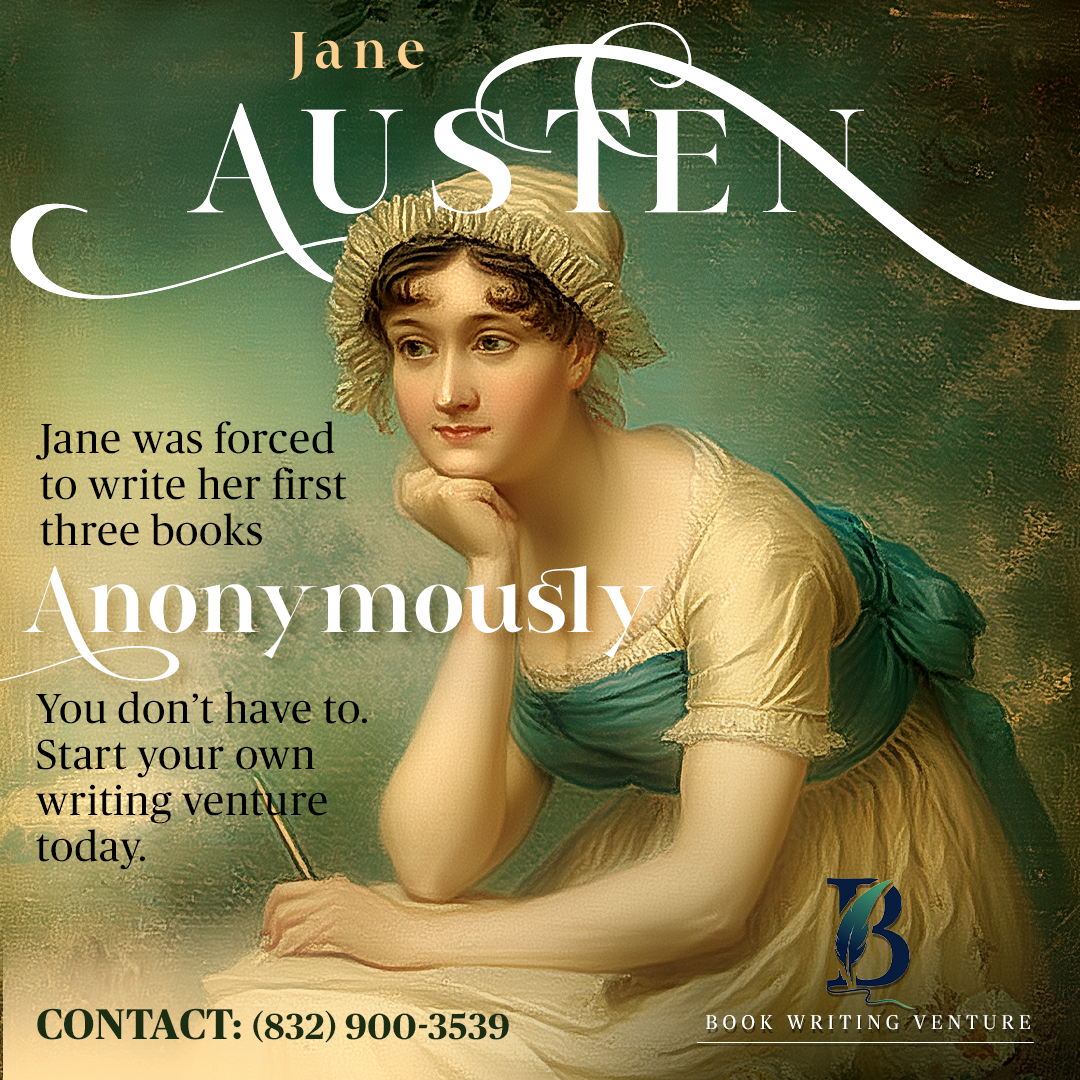
Jane Austen The Brilliant Woman Forced Into Silent Genius
Jane Austen The Brilliant Woman Forced Into Silent Genius | Book Writing Venture
In the gentle English countryside, long before her name became a symbol of literary mastery, a young Jane Austen wrote quietly by candlelight. With every stroke of her pen, she captured life, society, and love with a clarity that few writers have ever achieved. Her talent was undeniable, her imagination powerful, and her insight unmatched. Yet the world was never allowed to know her as the author of these masterpieces.
She was forced to publish her books anonymously.
Today, our associate Melissa from Book Writing Venture brought this story back into the spotlight, reminding us how far the writing world has come and how important it is to honor the women who carved a path in silence. Her passion for stories like Jane Austen’s inspired this article.
The Quiet Beginning of an Extraordinary Mind
Jane Austen was born in 1775 into a home filled with books, laughter, and lively intelligence. But unlike most young women of her time, Jane possessed a gift that set her apart. She also observed human behavior with striking accuracy. Every glance, every quiet worry, every unspoken desire around her became inspiration for her writing.
Her notebooks overflowed with characters who felt alive, relationships that reflected society, and stories that challenged the expectations of her era.
She had a gift.
But society did not want women to have gifts like hers.
A Woman Who Could Write But Could Not Be Seen
During Jane Austen’s lifetime, a woman who wrote professionally risked judgment and scorn. Women were expected to be modest, obedient, and unseen in public affairs. Publishing a novel openly as a woman could bring shame to the family, ridicule from society, and even professional rejection from publishers who rarely took women seriously.
So when Jane finished her first major work, Sense and Sensibility, society left her no choice. She could publish it, but not under her own name.
It appeared simply as By a Lady.
Her next novel, Pride and Prejudice, was credited only as By the Author of Sense and Sensibility.
Jane Austen, one of the greatest writers the world has ever known, was forced to hide behind a curtain of anonymity.
She created brilliance, but lived in silence.
A Ghost Behind Her Own Accomplishments
Readers across England adored her stories. Critics praised the writing. Publishers wanted more. Her characters became part of conversations in drawing rooms and tea houses. And yet, not a single reader knew her name.
There were moments when Jane attended social gatherings and heard people discussing her own books while she politely smiled, never revealing her authorship. She lived through the strange experience of watching her writing become popular while she remained invisible to the world.
She wrote for love, for passion, and for truth, not for recognition. But her invisible identity stood as a painful reminder of the restrictions placed on women of her time.
The Truth Revealed Only After Her Passing
Jane Austen passed away in 1817 at the age of forty one. She did not live long enough to witness her own greatness. Only after her death did her brother Henry reveal to the world that the author behind those remarkable novels was Jane Austen.
Her truth emerged too late for her to celebrate, but her legacy became unstoppable.
Why Melissa Brought This Story Forward
Melissa from Book Writing Venture believes stories like Jane Austen’s must be remembered. She often says that the hidden struggles of past writers remind us of the freedom and opportunity authors have today. She brought this story to our attention because she sees how many writers still question their worth, their talent, or their place in the world of publishing.
Jane Austen’s story proves that even when the world refuses to see a writer, their words can still shape generations.
Melissa’s dedication to recognizing and empowering writers aligns perfectly with the mission of Book Writing Venture.
How Book Writing Venture Honors Jane Austen’s Legacy
Where Jane Austen once lived in silence, modern authors now have the support and recognition she never received. At Book Writing Venture, we proudly offer the best writing, editing, designing, publishing, and marketing services in Florida. Our goal is to help every writer tell their story confidently, proudly, and without fear of being overlooked.
We assist authors with manuscript development, editing, book design, publishing, and professional marketing that gives them the visibility they deserve.
No writer today should ever feel anonymous.
Not while we stand with them.
Latest News

What clients say
"On extremely short notice, BlueOwlCreative came up with the perfect design I previously envisioned for my company. "

"Wow, just the template we were looking for! Stunning clean design, element rich, clean code and browser friendly!"

"Awesome theme! Very intuitive to use, clean coded, and easy to customize. Just rated 5 stars! Will strongly recommend!"


Bookwriting Venture is a leading authority in the literary realm, renowned for its expertise in crafting captivating narratives across various genres.
Useful Links
Our Services
Contact Info
 +1 (346) 668-7438
Orlando, FL, 32801, United States